
Monday, March 21, 2011 hosted the arrival of the first full day of spring, winter storm number who-knows-what, and the Barnard Educational Endeavor Society's annual dinner. The event was provided for by a generous, dedicated, and welcoming team at Twin Farms Resort and Spa located in Barnard, Vermont; and it was thanks to a fellow foodie friend of mine, who had kindly told me about the benefit dinner, that I became one of its 60 attendees.
Though I had passed by the Twin Farms grounds many times back when I used to commute between South Royalton and downtown Barnard, this was my first visit onto the premises. The resort is gated and tucked away from public access, specifically to give it that sense of a destination for a true escape. Driving into the courtyard was wonderfully enchanting with white lights lining the path up to the elegant country-inspired entrance. After stripping off our winter layers my friend and I proceeded into the establishment's adjacent rooms and were greeted by two more friends, two flutes of Champagne, and two delicate canapes. Both the curried turkey skewers with cranberry chutney and the carrot and ginger soup tantalized our taste buds and gave us a hint at the flavors that awaited us behind the dining rooms' closed doors.
Arriving at our table in a Champagnly chattable mood, we met two local couples who were to be our dining companions for the evening. Shortly we were joined by two baskets of house-made bread, which included delectably wholesome squares of Beidler wheat soda bread, a crusty walnut miche, slices of baguette, supremely soft Port Salute pepper rolls, and tangy and spicy Togarashi buttermilk biscuits - all accompanied by Vermont Butter and Cheese "Cultured" as well as Cabot butters, and an herb oil. Next we were graced with the pouring of wine number one, a 2005 Syrah of Novelty Hill with dark aromas and a lengthy finish, which paired well with an equally powerful dish of slow-cooked PT Farm beef with garden polenta, spinach, roasted cipollini, goats cheese, natural jus, and black truffle froth. Though I'm not ordinarily a fan of elaborate cooking methods - such as frothing - I certainly did not object to having a hint of truffle in every mouthful of tender beef and creamy, tangy polenta. The dish worked remarkably well, despite being perhaps a bit too powerful to kick off the meal, and the meat being a bit too dry. Sticking with the same glass of Syrah, the next course of wild mushroom and roasted garlic soup with chive oil and spelt croutons served to remind us just how purely succulent and creamy a pureed soup can be. Supplementing the perfectly smooth soup were the oil, croutons, and lightly sauteed whole mushroom, which each had their own way of bursting with flavor.
Our third course was preceded by a pouring of Raphael Sallet's 2008 Les Maranaches, which I eagerly tapped into, as Burgundy Chardonnay tends to be the only version of that varietal that I find palatable. With our glasses newly filled, out came an elegant plate of hot-smoked salmon with red cress, marinated potato, pickled sunburst squash, pink peppercorn emulsion, and olive oil potato crisps. The combination was again well-thought out and the smoky, flaky salmon enjoyed the company of a crunchy alternative pickle and the firm starchiness of the marinated potato. The emulsion carried the richness of a mayonnaise, and the potato crisp added a crisp dimension to each bite - a near carnival on a fork.
We quickly moved on to the third wine of the evening, a 2007 Rutherford, Provenance Cabernet Sauvignon - a Bordeaux - that was exceptionally spicy and full of body. This we had to accompany a course of sherry-glazed duck breast and confit leg served with local pepperoni lentils, roasted cauliflower, baby carrot, thyme broth, and Vermont alfalfa sprouts. The two pieces of duck were both phenomenally well prepared with the breast ideally rare but still with a tenderness that allowed it to melt in the mouth, and with the confit leg so flaky and moist. I would have preferred the dish without the pepperoni as I felt that it masked the more delicate flavor of the duck and lentils, and certainly over-powered the scent of thyme in the broth. Nevertheless the quality of the meat's preparation did surpass the authority of the pepperoni, and our palette cleanser to follow - a Fable Farm tomato sorbet with an 'Old Chatham' yogurt "Cheese", and a honey, plum and Lapsang jam - certainly provided the necessary essence to prepare our taste buds for the dessert portion of the meal.
Our cheese course was a selection made by four different Vermont producers, and were joined by a glass of a 2003 late-bottled vintage Taylor Fladgate Porto, some house made wheat crackers, and selection of accompaniments. Woodcock Farm's Humble Pie was featured with a plum and muscat jam, VT Shephards' Queso with salt and pepper almonds, Consider Bardwell Farm's Rupert with chile-glazed local popcorn, and Bonnieview Farm's Mossend Blue with apricot and artisanal membrillo. While I had tried each of these cheeses on individual occasions I thought the selection was nicely complementary and playful, with none of the cheeses overpowering another and the addition of accompaniments respectively.
The sweet portion of the meal came in two courses: first we were presented with a plate of four individual desserts including a 'Maracaibo' pots de creme with a Smuttynose 'Robust Porter' foam and smoked Maldon salt, a huckleberry ice cream sandwich with 'Edelweiss' mousse, and citrus crystals, an EVOO chocolate cake on tart cherry compote with gilden nibs pistachios and paint, and a burnt butter financier with tamari caramel caramelized banana peanuts and mint oil. Now to me this seemed like way too many flavors on one plate, and while I appreciated the effort on the chef's part to give us a well-rounded dessert experience and an experimental one at that, I found that my enjoyment of all four of the desserts at once was diminished by the shear quantity of tastes to experience. Regardless, the overall winner of the desserts was definitely the ice cream sandwich, which resembled a French-style macaroon with a filling of a sweet and tart creamy sorbet. Certainly the flavors and textures of the sandwich dessert were the most complementing of each other. In the other desserts the porter seemed too bitter for the dark chocolate mousse, the mint oil was hardly discernable on the palette next to the distinct caramel flavor of the financier dessert, and perhaps all the chocolate cake required to complete it was a small drizzle of an intensely chocolatey. In any case, dessert when it is prepared with care will always fare well with me, and I assure you that my plate was clean when it left the table.
Our second sweet course was a selection of petits fours, a very nice idea and I did my best to take full advantage of the bite-sized treats to round out our meal. We were treated to a currant pate - like a jelly - pecan sandies, grue truffles, pink peppercorn macaroons, chocolate chip cookies, beetroot toffee, and lemon marshmallows. These latter morsels proved to be my favorite as their lemony flavor and light-as-air texture were the ideal finishing touch for my taste buds.
The satisfaction I obtained from the whole experience was definitely attributable to the meal itself, but I must add that the people with whom I shared the night and from whom I received the perfectly hospitable service were themselves a most crucial component. So to the team at Twin Farms, to the B.E.E.S., and to Phyllis, David, Helene, Sarah, David, Mark, Margaret, and David I say thank you for a splendid occassion on a very confused first day of spring!
Tuesday, March 22, 2011


Sunday, March 20, 2011
A Tribute to VT Maple
This weekend was Vermont's maple open house weekend, and the weather could not have cooperated more. Although I missed excursions to the sugar houses, I did decide to try my hand at a completely invented maple desert on my part. The recipe is below, along with a not-so-nice picture of my finished product. I really should not be in charge of decorating and leave that bit to artistic folks!

Maple Swirl Cheesecake Tart
Crust
9 whole graham crackers, broken into pieces
1/4 cup maple sugar
1/3 cup butter, melter
1) Pulse the graham cracker pieces with the maple sugar in a food processor. When you achieve fine crumbs add the melted butter, and process again until the crumbs begin to stick together on the sides of the bowl.
2) Turn out the crumb into an 8-inch tart pan and press them into the bottom and sides of the pan so that the crust is of an even thickness and covering the whole pan.
3) Bake the crust in a 350-degree oven for 7 minutes and allow to cool once removed.
Filling
8 oz cream cheese (we were low on this ingredient so I used yogurt to cover the remaining of the weight)
1/4 cup maple syrup
1/4 cup sour cream
3 gelatin leaves, soaked, squeezed, and melted in microwave
1/2 heavy cream, whipped until stiff
1) Combine the cream cheese and maple syrup together in a mixing bowl and whisk together. Add the sour cream and whisk again. Then add the melted gelatin and whisk just until it is even incorporated.
2) Fold the whipped cream into the bowl, making the filling as light as possible.
3) Pour the filling into the cooled graham cracker crust.
Maple Syrup Caramel
1/4 cup maple sugar
2 tblsp butter
1/4 cup heavy cream
1 tsp rum
1) Heat the maple sugar with one tsp of water in a heavy bottom pan set over medium high heat. Once the sugar has liquefied, add the butter and swirl the pan to mix it in. Next add the cream and bring the mixture to a low simmer and allow it to cook for about 5 minutes. Finally add the rum and allow it to boil to cook off the alcohol.
2) Allow the caramel to cool slightly and then pour it over the filled tart as desired. I tried to be artistic using the tip of a knife, but as so often happens with my little experiments, the art turned very messy. Nevertheless the end result was tasty and a good toast to VT's Maple Open House Weekend.
P.S. The aromas that linger after making this tart might make you think of pancakes;)

Maple Swirl Cheesecake Tart
Crust
9 whole graham crackers, broken into pieces
1/4 cup maple sugar
1/3 cup butter, melter
1) Pulse the graham cracker pieces with the maple sugar in a food processor. When you achieve fine crumbs add the melted butter, and process again until the crumbs begin to stick together on the sides of the bowl.
2) Turn out the crumb into an 8-inch tart pan and press them into the bottom and sides of the pan so that the crust is of an even thickness and covering the whole pan.
3) Bake the crust in a 350-degree oven for 7 minutes and allow to cool once removed.
Filling
8 oz cream cheese (we were low on this ingredient so I used yogurt to cover the remaining of the weight)
1/4 cup maple syrup
1/4 cup sour cream
3 gelatin leaves, soaked, squeezed, and melted in microwave
1/2 heavy cream, whipped until stiff
1) Combine the cream cheese and maple syrup together in a mixing bowl and whisk together. Add the sour cream and whisk again. Then add the melted gelatin and whisk just until it is even incorporated.
2) Fold the whipped cream into the bowl, making the filling as light as possible.
3) Pour the filling into the cooled graham cracker crust.
Maple Syrup Caramel
1/4 cup maple sugar
2 tblsp butter
1/4 cup heavy cream
1 tsp rum
1) Heat the maple sugar with one tsp of water in a heavy bottom pan set over medium high heat. Once the sugar has liquefied, add the butter and swirl the pan to mix it in. Next add the cream and bring the mixture to a low simmer and allow it to cook for about 5 minutes. Finally add the rum and allow it to boil to cook off the alcohol.
2) Allow the caramel to cool slightly and then pour it over the filled tart as desired. I tried to be artistic using the tip of a knife, but as so often happens with my little experiments, the art turned very messy. Nevertheless the end result was tasty and a good toast to VT's Maple Open House Weekend.
P.S. The aromas that linger after making this tart might make you think of pancakes;)
Sunday, March 13, 2011
The Flapjack - AKA The Energy/Muesli/Granola Bar
When I worked in England, I discovered the flapjack - also known as muesli bars - or what seemed like to me a less healthy, baked version of a granola bar. Although many of the packaged flapjacks I tried were quite tasty, they never really seemed like an appropriate alternative to a dessert for me - especially when I had an alternative of sticky toffee pudding, bread and butter pudding, or another similar warmed and gooey dessert. This was the case until I endeavored to make my own flapjack-like creation. I initially began with a recipe from my boss' Hummingbird Bakery cookbook and soon realized just why the bar was loaded with so much fat and calories. With butter pulling much of the weight in the recipe and a syrupy sugar mixture pulling the most, it was no wonder that the fat and calorie content of the granola bar look-a-like was comparable to a spongy custardy pudding. Needless to say these flapjacks were wonderful and they instantly became one of my favorite things to make because they were so easily adaptable. However a part of me couldn't help but gulp every time I added the 325 grams of butter and the near 500 grams of both golden syrup and brown sugar.
When I returned to the states, I soon forgot about the flapjacks/muesli bars. I have only just recently begun to think about them again thanks to my continuous endeavor to be able to accommodate some of today's dietary restrictions and preferences. Anyways, these bars quickly popped into my head during my attempts to develop some healthier alternatives to desserts, but that didn't compromise on their taste and texture factor. The flapjack seemed like a perfect adaptable concoction, but it definitely needed modification. Thus I did a bit of exploring and research and this is what I came up with after a couple of goes. It might be better suited to be the title of energy bar because it really could be that healthy, and therefore maybe I have swayed too far from the flapjack. I call them "muesli bars" because to make them I do actually use a store-bought, albeit organic muesli with raisins, hazelnuts, quick rolled oats, and wheat flakes.
Note: Any of the seeds, nuts, and dried fruit can be substituted with any other and you can easily play with flavors in this.
Muesli Bars
1 cup muesli - you could also substitute rolled oats
1 cup unsweetened desiccated coconut
3 Tblsp wheat germ
1/4 cup sesame seeds
1 cup hazelnuts
1 cup raisins
1/3 cup flax seeds
2 tblsp butter
2/3 cup honey
1) Prepare an 8x8" square baking pan by greasing it and lining it with parchment paper.
2) Heat a large frying pan over medium high heat, and add the muesli/oats, coconut, wheat germ, and sesame seeds. Toast the mixture for about 5 minutes while stirring occasionally. Transfer the ingredients to a large mixing bowl to cool.
3) Next add the hazelnuts to the pan and toast them shaking the pan from time to time. After about five minutes remove the hazelnuts to a paper towel or a dish towel and rub the nuts between the towel and each other so as to remove their skins. Roughly chop the hazelnuts and add them to the mixing bowl with the raisins and flax seeds.
4) Finally reduce the heat to medium and add the butter and the honey to the pan. Stir the butter and honey to combine then allow to simmer in the pan for 3-5 minutes without stirring.
5) Pour the hot mixture in with the dry ingredients and toss everything together until the ingredients are evenly combined.
6) Transfer the contents of the bowl to the prepared pan and set a piece of parchment paper over the top. Press the mixture down evenly into the pan.
You can allow the pan to cool at room temperature, but as I tend to want to cut into the bars sooner rather than later, I put the pan into the refrigerator and weigh it down with various items for about an hour.
When I returned to the states, I soon forgot about the flapjacks/muesli bars. I have only just recently begun to think about them again thanks to my continuous endeavor to be able to accommodate some of today's dietary restrictions and preferences. Anyways, these bars quickly popped into my head during my attempts to develop some healthier alternatives to desserts, but that didn't compromise on their taste and texture factor. The flapjack seemed like a perfect adaptable concoction, but it definitely needed modification. Thus I did a bit of exploring and research and this is what I came up with after a couple of goes. It might be better suited to be the title of energy bar because it really could be that healthy, and therefore maybe I have swayed too far from the flapjack. I call them "muesli bars" because to make them I do actually use a store-bought, albeit organic muesli with raisins, hazelnuts, quick rolled oats, and wheat flakes.
Note: Any of the seeds, nuts, and dried fruit can be substituted with any other and you can easily play with flavors in this.
Muesli Bars
1 cup muesli - you could also substitute rolled oats
1 cup unsweetened desiccated coconut
3 Tblsp wheat germ
1/4 cup sesame seeds
1 cup hazelnuts
1 cup raisins
1/3 cup flax seeds
2 tblsp butter
2/3 cup honey
1) Prepare an 8x8" square baking pan by greasing it and lining it with parchment paper.
2) Heat a large frying pan over medium high heat, and add the muesli/oats, coconut, wheat germ, and sesame seeds. Toast the mixture for about 5 minutes while stirring occasionally. Transfer the ingredients to a large mixing bowl to cool.
3) Next add the hazelnuts to the pan and toast them shaking the pan from time to time. After about five minutes remove the hazelnuts to a paper towel or a dish towel and rub the nuts between the towel and each other so as to remove their skins. Roughly chop the hazelnuts and add them to the mixing bowl with the raisins and flax seeds.
4) Finally reduce the heat to medium and add the butter and the honey to the pan. Stir the butter and honey to combine then allow to simmer in the pan for 3-5 minutes without stirring.
5) Pour the hot mixture in with the dry ingredients and toss everything together until the ingredients are evenly combined.
6) Transfer the contents of the bowl to the prepared pan and set a piece of parchment paper over the top. Press the mixture down evenly into the pan.
You can allow the pan to cool at room temperature, but as I tend to want to cut into the bars sooner rather than later, I put the pan into the refrigerator and weigh it down with various items for about an hour.
Monday, March 7, 2011
Hogwash Goulash
Yucky day #3 and the promise of March's winter Norwich farmer's market this coming Saturday, had me rummaging through the freezer for inspiration for tonight's dinner. I came across a roughly 2-lbs boneless pork shoulder that I had procured from Norwich's very own Hogwash Farm at February's farmer's market. I decided to pull it out and allowed it to defrost for the first half of the day, still vacuum-packed, in a container of room-temperature water. In the meantime I went about my usual research process of sourcing ideas for preparation. I had come across a spicy pork goulash about a month ago, and liked the sound of that minus the heat. Thankfully we keep a good stock of sweet paprika at home as well as some other dried herbs and spices that can often be found in goulash variations. Bingo.
With my pork cut no longer resembling a block of ice, and with the herbs and spices at the ready, I began my process. The first step was to cut the meat into cubes, and the rest follows below in pictures and words. I must first note however that according to Wikipedia, in a traditional goulash - meaning soup - flour should never be used, and instead is ideally thickened with potato that is added to the dish at its outset. Nevertheless, as I wasn't necessarily going for authenticity, and prefer to have whole potatoes with my meat and sour cream rather than as a indiscernible component; I decided to opt for dredging the meat in flour to achieve the viscosity for which I was hoping. Here we go!

1.5 tblsp vegetable oil, or other neutral oil
1 onion, sliced thinly
Method:


I chose to serve my goulash not so traditionally with some paprika baked potatoes and sauteed spinach.
With my pork cut no longer resembling a block of ice, and with the herbs and spices at the ready, I began my process. The first step was to cut the meat into cubes, and the rest follows below in pictures and words. I must first note however that according to Wikipedia, in a traditional goulash - meaning soup - flour should never be used, and instead is ideally thickened with potato that is added to the dish at its outset. Nevertheless, as I wasn't necessarily going for authenticity, and prefer to have whole potatoes with my meat and sour cream rather than as a indiscernible component; I decided to opt for dredging the meat in flour to achieve the viscosity for which I was hoping. Here we go!

Hogwash Farm Pork Shoulder Goulash:
Ingredients:
1 tsp caraway seeds1.5 tblsp vegetable oil, or other neutral oil
~2 lbs boneless pork shoulder (Boston Butt), cut into large cubes
1/3 c. flour1 tsp each salt and ground black pepper
3 tblsp paprika1 onion, sliced thinly
2 garlic cloves, roughly chopped
1 tblsp cider vinegar
1 tblsp dried marjoram
12 oz lager
1 tblsp molasses
1) Heat a heavy-bottomed pot/dutch oven over medium high heat. Meanwhile combine the flour with 1 tblsp paprika, and the salt and pepper in a shallow dish. Toss the pork cubes in the flour until they are completely coated.

2) Add the tsp of caraway seeds to the pot and allow to dry toast for 20-30 seconds or until they become fragrant. Add 3/4 tsp of the oil and when the seeds start to sizzle add 1/2 of the meat, so as not to overcrowd. Allow the meat to sear and then turn so that each side cooks evenly. Remove the first batch of meat, add the remaining 3/4 tsp of oil and the remaining meat. Repeat.

3) Once all the meat has been removed from the pan add the onions and saute until they become transluscent. Pour in the cider vinegar, scraping the bottom of the pan as you do so as to remove all the borwned bits. Add in the chopped garlic, the remaining 2 tblsp of paprika, and the the marjoram. Stir everything to combine and top with the meat.
4) Pour in the lager and enough water so that the liquid comes up high enough to cover all the meat. Finally add in the molasses, stir, and bring the liquid to a simmer.

5) Reduce the heat to medium low and allow the dish to cook for 1 and 1/2 to 2 hours, or until the meat reaches your desired tenderness.

Monday, February 21, 2011
Lapin a la Moutarde
For those of you with a fondness for Thumper, Bugs Bunny, or Peter Rabbit, I might suggest that you not reader further. However, for those of you whose palates have been graced with the tender and gamey yet mild and sweet rabbit mead then hopefully you will enjoy this post.
My mom and I ventured to the Lebanon Farmer's Market this past weekend in search of what is left to find of winter's bounty in the Upper Valley. Although as far as produce was concerned we only managed to come away with a pound or so of yellow onions, we were excited by a new-to-us lineup of vendors. When we were nearly finished with our loop we came to a vendor with a sign for Dunrovin farm in Claremont, NH. What grabbed our attention at this particular stand, which looked similar to the rest with its array of coolers holding a variety of frozen meats, was its sign claiming to have whole rabbits. Immediately our European genes demanded that we stop, and thankfully the farmer still had rabbits to sell. We quickly snatched up one of 3.9 lbs, and left extremely proud of our snag.
Throughout the day as my parents and I discussed our preferences for cooking the animal, I also began to think about who in our circle of acquaintances would be wholly appreciative of sharing the meal with us. I quickly arrived at the names of two former co-workers of mine, and rang them with an invitation to dinner the next evening.
After much deliberation and the pulling out cook books and the searching of the internet, my parents and I finally settled on Rabbit with Mustard - a simple French peasant dish that had each of us in salivation mode. The next day I set to work, and I must say that the results were ideally suited for a meal of good food and good friends. The following recipe is one I took from a French recipe site: gourmandines.fr, and while I did do some tweaking I felt it best to stick to the simplistic nature of the original. I did choose however to cook the rabbit for about twice as long as the recipe called for simply because of my preference for the utmost tenderest meat possible. This is of course not necessary as rabbit meat is already fairly tender, but I would suggest it if you want a deeper flavor.
Lapin a la Moutarde
Ingredients
1 tblsp butter
2 tblsp olive oil
1 rabbit (3.9 lbs is slightly large, but it allowed us to feed 5 people with a tiny bit leftover)
4 tblsp Dijon mustard - I substituted 1 tblsp with grain mustard
salt and pepper
1 tblsp tarragon
3 shallots, roughly chopped
1 cup white wine
2 cups rabbit stock - I used the rabbits backbone to make this quantity of stock, but you could just as easily use chicken stock
2 tblsp heavy cream


2) Next you may want to rinse each piece, as some fine little hairs might still present in some places. After drying the pieces proceed with seasoning each first and then applying an even coat of a mixture of 2 tblsp of Dijon mustard and the 1 tblsp of grain mustard to one side of each piece.

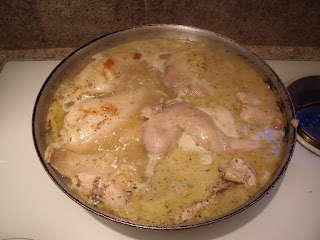


My mom and I ventured to the Lebanon Farmer's Market this past weekend in search of what is left to find of winter's bounty in the Upper Valley. Although as far as produce was concerned we only managed to come away with a pound or so of yellow onions, we were excited by a new-to-us lineup of vendors. When we were nearly finished with our loop we came to a vendor with a sign for Dunrovin farm in Claremont, NH. What grabbed our attention at this particular stand, which looked similar to the rest with its array of coolers holding a variety of frozen meats, was its sign claiming to have whole rabbits. Immediately our European genes demanded that we stop, and thankfully the farmer still had rabbits to sell. We quickly snatched up one of 3.9 lbs, and left extremely proud of our snag.
Throughout the day as my parents and I discussed our preferences for cooking the animal, I also began to think about who in our circle of acquaintances would be wholly appreciative of sharing the meal with us. I quickly arrived at the names of two former co-workers of mine, and rang them with an invitation to dinner the next evening.
After much deliberation and the pulling out cook books and the searching of the internet, my parents and I finally settled on Rabbit with Mustard - a simple French peasant dish that had each of us in salivation mode. The next day I set to work, and I must say that the results were ideally suited for a meal of good food and good friends. The following recipe is one I took from a French recipe site: gourmandines.fr, and while I did do some tweaking I felt it best to stick to the simplistic nature of the original. I did choose however to cook the rabbit for about twice as long as the recipe called for simply because of my preference for the utmost tenderest meat possible. This is of course not necessary as rabbit meat is already fairly tender, but I would suggest it if you want a deeper flavor.
Lapin a la Moutarde
Ingredients
1 tblsp butter
2 tblsp olive oil
1 rabbit (3.9 lbs is slightly large, but it allowed us to feed 5 people with a tiny bit leftover)
4 tblsp Dijon mustard - I substituted 1 tblsp with grain mustard
salt and pepper
1 tblsp tarragon
3 shallots, roughly chopped
1 cup white wine
2 cups rabbit stock - I used the rabbits backbone to make this quantity of stock, but you could just as easily use chicken stock
2 tblsp heavy cream

1) First it is necessary to cut the rabbit into 8 pieces. You could have a butcher do this for you if you are lucky enough to have one handy, but otherwise the process is not too challenging. I began by cutting off the hind legs by slicing through the flesh and joint where they join with the middle portion of the rabbit. Next I removed the fore legs, by cutting right along the bottom the rib cage and then using a cleaver to remove the backbone from the center of the rib cage. Finally I chose to cut the sadde of the rabbit into three relatively equal pieces, so as to provide a tasting portion for those who would want it.
2) Next you may want to rinse each piece, as some fine little hairs might still present in some places. After drying the pieces proceed with seasoning each first and then applying an even coat of a mixture of 2 tblsp of Dijon mustard and the 1 tblsp of grain mustard to one side of each piece.
3) Heat a heavy-bottomed skillet over medium heat with the butter and oil. When the butter has melted and begins to foam add the rabbit pieces one by one with the mustard-side facing down. Sear the pieces for about five minutes and in the meantime sprinkle the upward-facing side with the tarragon. Turn each piece over and allow to cook on the other side for another five minutes or so. Evenly distribute the shallots over the top of the pieces.

4) Add the cup of wine and bring to a gentle simmer. Cook for 10 minutes to reduce the wine slightly and concentrate its flavor, and then add enough stock so as the rabbit is almost completely submerged.

5) At this stage I allowed the dish to simmer and cook for a good hour and a half, but 40 minutes should be all it needs to cook through and achieve a diserable tenderness. Whenever you feel that the rabbit has cooked long enough, remove the pieces from the pan temporarily to a clean surface. I did this so as to avoid too much of a mess when adding the remaining tblsp of mustard and the 2 tblsp of cream. Plus this allows you to reduce the sauce as much or as little as you like without jeopardizing the quality of the meat. Return the meat to the pan and rewarm in the sauce as necessary.

We served our Lapin a la Moutarde accompanied by fresh homemade paparadelle pasta, and crusty King Arthur Flour baguette; followed by a green salad, and a selection of local cheeses, and finally an Italian-inspired hazelnut cake with a strawberry salad. We drank a white wine following our Kir cocktails, but you could easily enjoy this dish with a mellow and refined red.

Bon Appetit my food friends!
Tuesday, February 8, 2011
A Tribute to Bob's Red Mill

For those of you who have not been there before, I strongly suggest that you take a trip to your nearest Ocean State Job Lot as soon as possible. Well, maybe don't take a trip expressly with Ocean State as your destination, but certainly if you drive by one, make the point to stop in for a visit. Really I only go there for their eclectic food section. They seem to have foods of all nationalities, and while I probably wouldn't venture to buy something that has a delicate shelf life, they certainly offer some very good steals and finds. On my most recent trip I took the time to peruse the vast selection of Bob's Red Mill products that lined half the shelves of one aisle. The company offers practically every type of whole grain that could possibly exist, and then some with their wide variety of mixes. I chose a package of their vegi soup mix, consisting of a tempting combination of green and yellow split peas, barley, lentils, and flavors of alphabet pasta bits made from wheat flour, spinach, and tomato.

And so it was, after a walk and a romp on this snowy afternoon with a certain favorite companion of mine, that I decided tonight would present the perfect opportunity for a soup. As is typical of winter, our refrigerator has been taken over by several varieties of pork products as well as some very hearty vegetables. I pulled out some kale and a piece of Kielbasa, as well as the 3 or so cups of veal stock I had previously frozen. I then took out my soup mix, which recommends that you allow 1 part of the mix per 4 parts of liquid, and fired away. I served the soup with some artisan sourdough bread, which slathered with some garlic butter and toasted up, but any hearty bread would work nicely. If you don't have access to Bob's Red Mill Products you could easily make your own soup mix with any variety of the same ingredients, or even try some of your own.
Kale, Kielbasa, and Bob's Red Mill Vegi Soup Mix Soup
Ingredients
6 cups stock, water, bouillon, etc...
1.5 cups Bob's Red Mill Vegi Soup Mix
1 clove of garlic, finely chopped
1 onion, halved and finely sliced
1 large bunch of kale, washed and torn from tough stems
1 good-sized piece of Polish kielbasa, cut into bite-sized pieces
1tblsp neutral oil
1) Bring whatever liquid you are using to a boil in a heavy-bottomed pot, and add the soup mix. Cover, and allow the mix to simmer for 45 minutes to an hour. You may add more liquid as you go depending on how much you lose to evaporation
2) Meanwhile heat the oil in a large frying pan and saute the kielbasa in a frying pan for 5 minutes. Add the finely sliced onion and saute gently, stirring frequently, until the onions become slightly caramelized. Add the garlic and just after, the kale. Allow the kale to wilt, stirring so that it becomes evenly cooked.
3) When the kale is cooked to your liking - I like it with just a little bite still - reduce the heat on your soup base to low, and add in the contents of the frying pan. Using a large spoon comine all the ingredients together and your soup/stew is ready to go!

A truly winter-warming meal

Wednesday, January 26, 2011
Beef Marrow Dinner
I can't really take credit for the preparation of my dinner tonight, but it was simply too delicious to let it go without a post. I am housesitting, and so forced to prepare meals for one, which I will admit is not very inspiring. Thus, when I was plating an entree dish at work today - slow roasted beef shins - and asked to take the meat off the bones in order to make the portions and dish more presentable; I was happy to oblige as this rendered the beef marrow bones as otherwise unusable. I removed the fatty gelatinous pieces of marrow from their protective shells with the opposite end of a spoon, and reserved for tonight's dinner, which I proceeded to anticipate the rest of my day.

 For the preparation I lightly toasted a slice of multigrain bread, and microwaved my portion of marrow for about 30 seconds. I spooned the marrow onto the bread allowing the melted fat to drip onto the bread. I accompanied the marrow toasts with some beat salad atop some arugula that I had also put together at work today. Voila, I truly lavish dinner of marrow toasts and beet salad.


Subscribe to:
Posts (Atom)


